Motivation
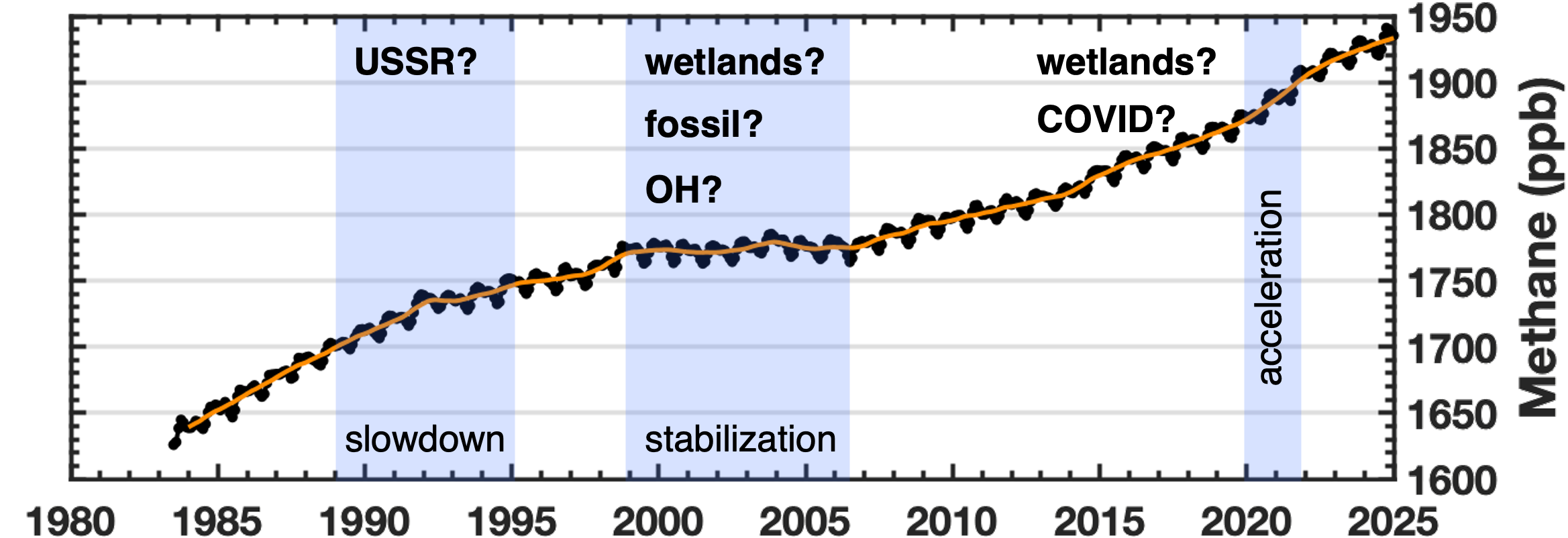
Since the late twentieth century, atmospheric methane has exhibited complex behavior, including periods of rapid growth, stabilization, and renewed acceleration. These changes have occurred alongside major shifts in energy production, land use, agricultural practices, and climate variability, making attribution particularly challenging.
Despite the availability of extensive surface, aircraft, and satellite observations, substantial uncertainty remains regarding the relative contributions of different methane sources and the role of atmospheric sinks. In particular, changes in methane emissions from wetlands, fossil sources, and the chemical removal via the hydroxyl radical (OH) are often hypothesized as drivers of the variations. Disentangling emissions-driven changes from chemically driven variability is a central challenge for interpreting the modern methane record.
Key Research Questions
- What are the dominant drivers of observed methane trends since the 1980s?
- How have changes in OH and other oxidants affected methane lifetime in recent decades?
- Can atmospheric measurements, satellite data, and inverse modeling be reconciled into a consistent picture of methane sources and sinks?
- How do climate variability and extreme events modulate year-to-year methane emissions?
Relevance to FETCH4
FETCH4 addresses these questions by combining global observations, chemical transport modeling, and machine-learning approaches. The goal is to reduce uncertainty in methane source attribution and sink variability during the modern observational era.